Well Fed: fried snacks
An assortment of good meals and memories illustrated through terrible food photography.

Trust me when I say I wanted to launch this blog with a food post. Unfortunately, my first attempt was a bloated google doc of meandering thoughts, incomprehensible even to me. So I am instead reining it in with themed lists of fun things I’ve eaten this year on my travels, the first of which is dedicated to fried snacks. The next instalment will be the ‘inexplicably Vietnamese’ edition – no further explanation.
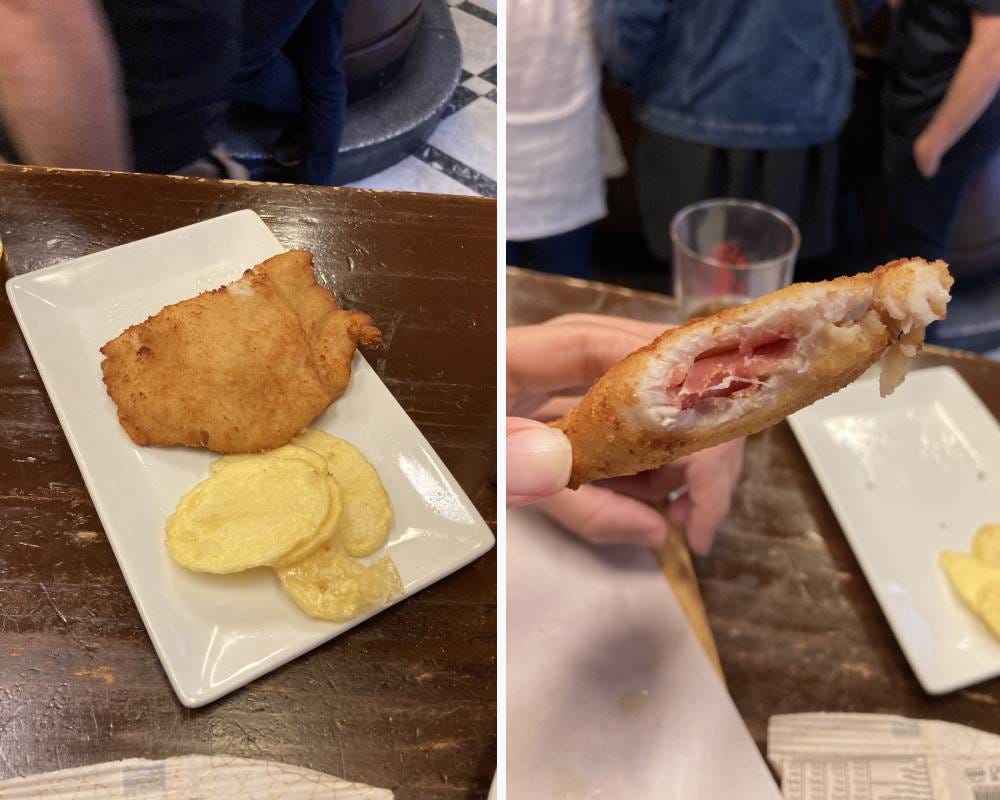
San Jacobo
My body was 90 per cent Iberico ham by the time we left Seville. Breakfast at the gourmet market: a giant plate of sliced jamon. Lunch: a cheese, jamon and olive oil roll. Dinner: an assortment of tapas featuring… you guessed it. At Casa Morales, a bar that dates back to 1850, we enjoyed our first San Jacobo Iberico. A San Jacobo is basically a folded slice of ham and cheese that’s breaded and fried. Clearly, there is no universe in which this combination of ingredients could taste bad. In fact, I’m certain you could recreate a San Jacobo in a half-drunken state using regular sliced cheese and supermarket ham and still end up with a moreish, golden brown snack. Do try it.
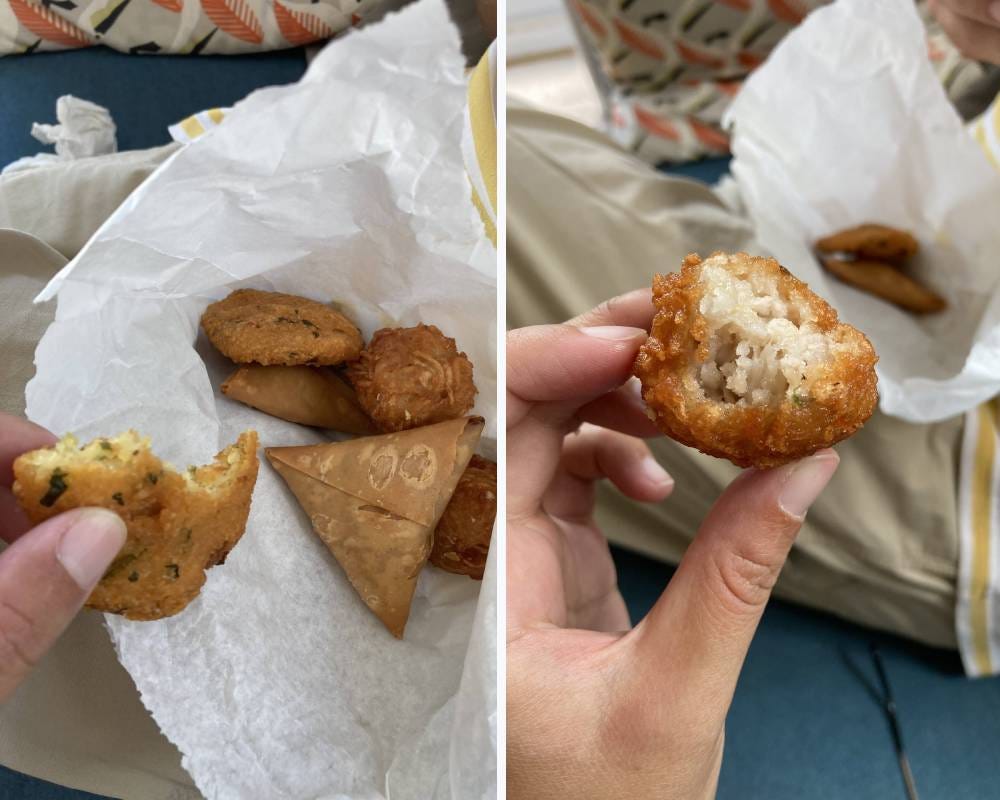
Mauritian gateaux
I love that London’s high streets overflow with treats you can pick up for a mere pound or two. I felt like an excited school kid, whose long bus or tube ride home could be made all the better by a freshly fried snack. Shout out to the numerous Nigerian puff puff shops, the fresh circular tulumba from Durak Tantuni (it was like jalebi in doughnut form) and the coxinhas at Reis Food Market, which all made me very happy during my time in LDN. One place I wish I got to go back to was the Mauritian restaurant Le Chamarel, which I found on a Vittles round-up (to be clear, 90 per cent of what I ate in London was recommended by Vittles). I zoomed there on an electric Lime bike at what felt like 30km/hour, which felt equal parts exhilarating and terrifying since I was without a helmet. Still shaken by the discovery that I have an inner speed demon, I stumbled into Le Chamarel and sweatily pointed at an assortment of unlabelled fried balls. What I took home were popular street snacks: gateau arouille (taro fritters), gateau piment (‘chilli cake’) and chicken samosas. Maybe it’s a Southeast Asian thing, but I always, always appreciate a savoury snack that is on the cusp of being too sweet. It’s like the joy of alternating between bites of fresh Maccas fries and licks of soft serve. My brain just lights up. And so naturally I loved the salty-sweetness of the gateau arouille, that lovely crunch on the outside and how the grated taro inside took on a texture that was reminiscent of a fish ball (even though there is no fish involved). Does it have something to do with it being a Mauritian-Hakka snack? Or maybe my brain just leapt to the fishball association for no good reason. In any case, I immediately wanted to eat 10 more. The gateau piment was fantastic too – a wonderful hit of spice – and the samosa I don’t remember much about, but it must have been decent because Ross didn’t complain (he is picky with samosas). I am accepting tips on where to eat all of these in Melbourne, so please share if you are in the know!
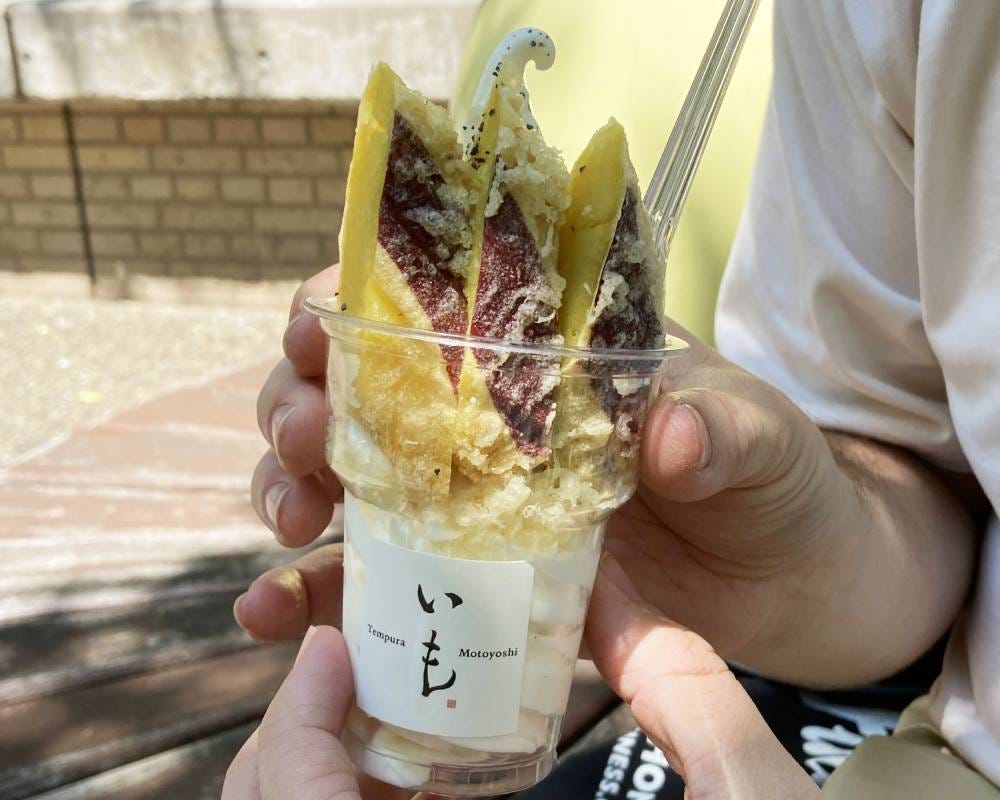
Tempura
We spent a week in Tokyo back in May, squeezing in as much food as humanly possible. On our last morning, Ross was still raring to go, insisting that we trek to Tempura Motoyoshi Imo, the takeaway version of the Michelin-starred restaurant Tempura Motoyoshi. From their small, tastefully decorated shop in Daikanyama, you can buy only one thing: sweet-potato tempura, available in luxuriously packaged boxes, single servings or delicately placed atop milk soft serve. We selected the latter, and sat on a bench across the street, digging our spoons into the little cup of textural perfection. The tempura batter was light and crisp, and the sweet potato inside still soft and warm. The soft serve, with its little flecks of salt, was the ultimate supporting act. Heaven!
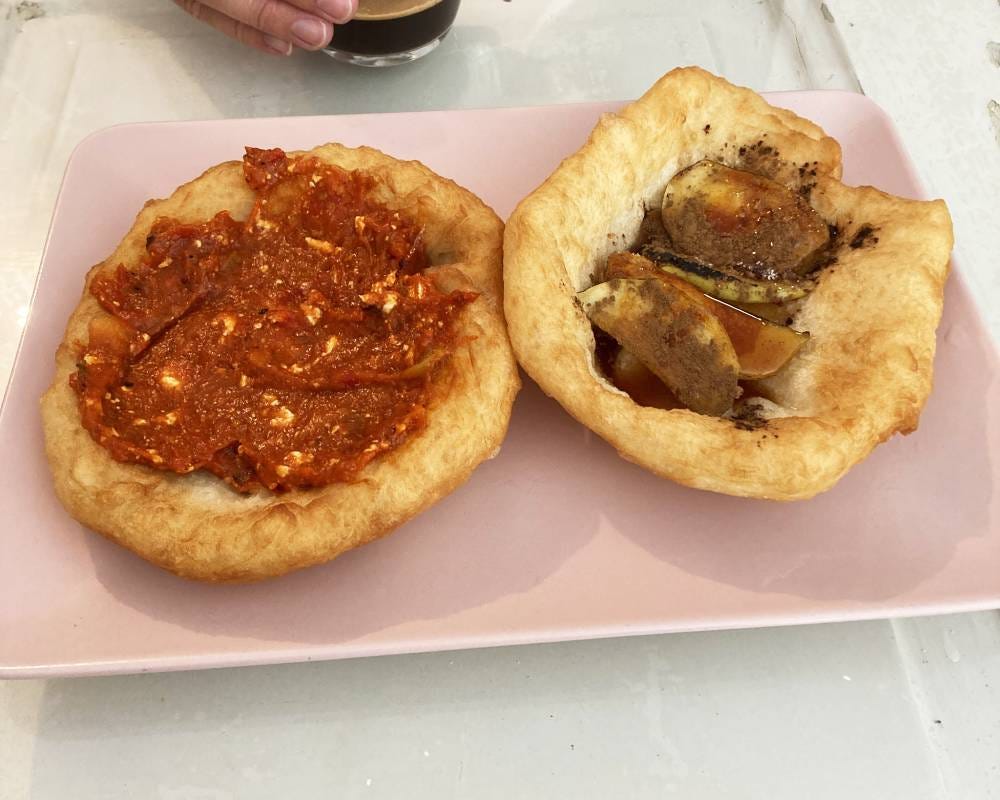
Mekitsa
I know this is essentially a listicle of fried dough, but I’ll be the first to admit that I can tire of the stuff pretty quickly. Not so at Mekitsa & Kafe in Sofia, Bulgaria, though. On our two visits, staff would fry us up a fresh batch on the spot. What landed on our plate remained crisp on the outside and pillowy and light on the inside, even once the toppings hit the surface. That meant I could easily eat two or three mekitsa in one sitting. Ross enjoyed his with apple and walnut or berry jam, but my favourite topping was cheese and lyutenitsa, a Bulgarian red paste made from capsicum, tomato and spices. As I was chewing on my third mekitsa, I looked up the impressive family of Balkan red pepper pastes, which includes everyone’s favourite ajvar. It left me wondering whether Turkish acuka, Georgian adjika and the Levantine muhammara, each with its own regional variation, could be classified as part of this extended family too. My knowledge in these cuisines is lacking so please do weigh in. And while you’re there, send me your favourite jarred brands of ajvar/lyutenitsa/acuka!

Empanada
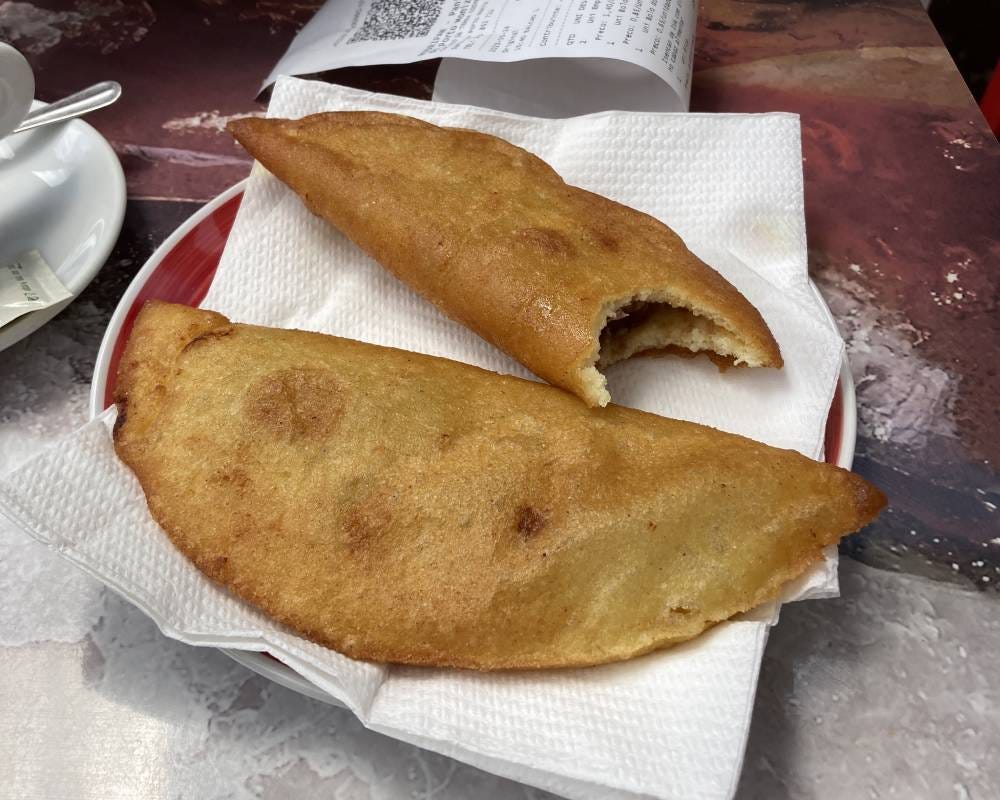
I was awestruck by the landscape in Madeira. While it’s technically a Portuguese archipelago, Madeira is geographically closer to Morocco than Europe, and its mountainous terrain is in fact the top of a dormant volcano which extends deep into the sea. The food though… kind of a letdown. Outside of grilled limpets and bolo do caco (both great), restaurant menus leaned towards stodgy plates of chips and meat. The best thing I ate was at Rodripan, a bakery run out of the bottom of a house not dissimilar in style to a suburban Italian–Australian brick mansion. We ordered beef empanadas, each half moon the length of my face. I couldn’t get over the texture. The pastry had an ever-so-slight chew and was an ideal thickness for a satisfying, savoury bite. Due to my non-existent Portuguese, I could not enquire as to whether this was a Madeiran specialty, though later research suggested we’d potentially eaten a Venezuelan or Colombian-style empanada (plausible, as there is a sizeable Venezuelan community in Madeira).
More empanadas
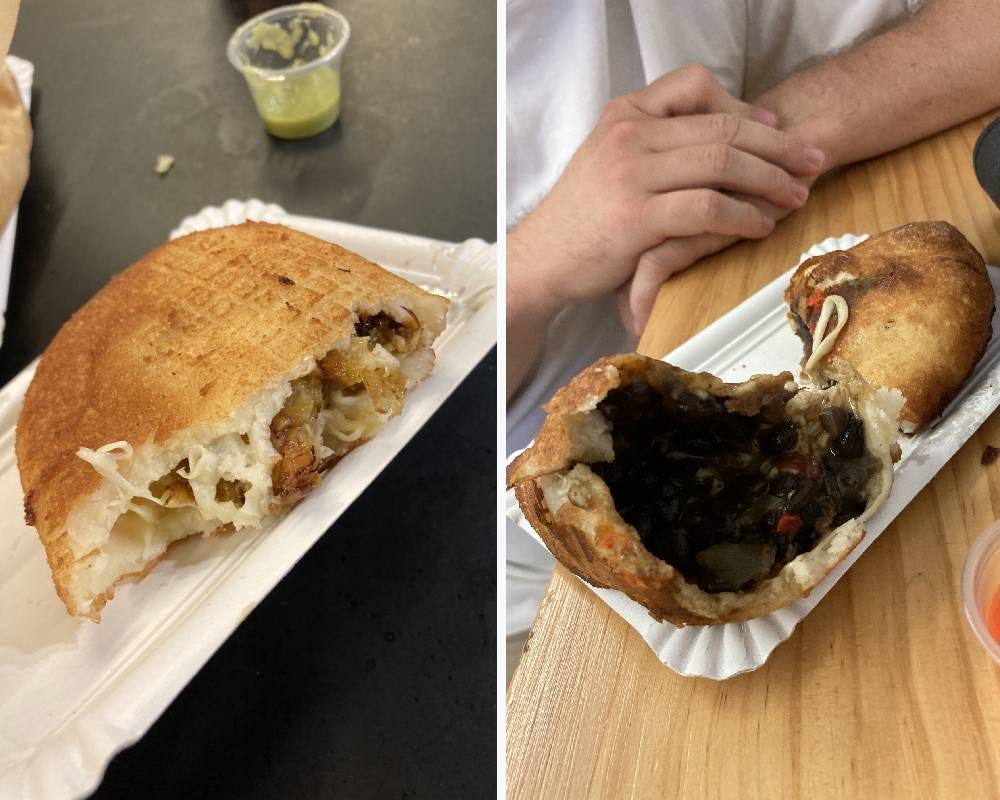
Once I discovered that cornmeal empanadas are my thing, I insisted on frequenting the Venezuelan food stall O Luar when we got to Madrid (the entire San Fernando market had been recommended by a friend). I became obsessed with the piping-hot plantain and cheese empanada in particular, which reminded me a little of my mum’s Vietnamese banana fritters. The slow-cooked beef and cheese flavour was also solid, though the black bean and cheese empanada was less exciting to me. In general, I was so psyched to eat Latin American food in Madrid – the sheer variety available there blew me away. I also had the best tacos of my life in Madrid, a sad reminder of just how low the bar is in Melbourne.
Pastechi bakkeljauw / bakijou
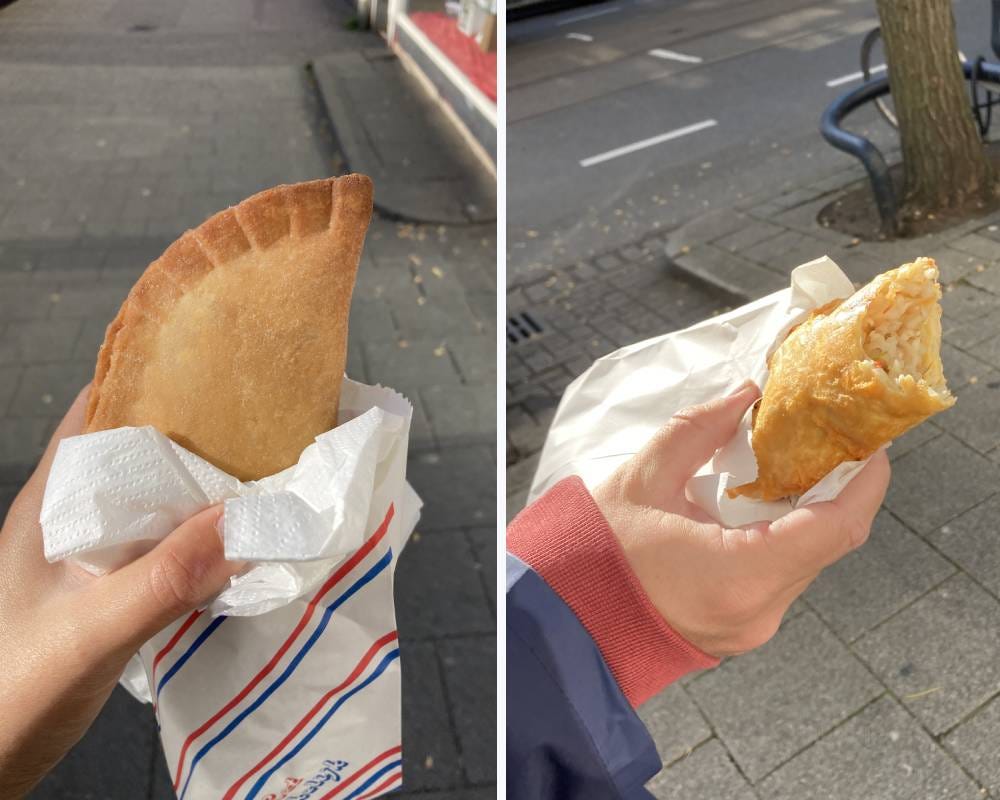
We were in Rotterdam recently, killing time in Chinatown before meeting up with my cousin, when Toko Nobo caught my eye. Customers were buying bags worth of golden pastries from the bain-marie up the front. So I joined the queue and picked out a pastechi bakkeljauw and loempia, not really knowing what to expect. The pastechi bakkeljauw (bakkeljauw = bacalhau = bacalao) was a delight – a sweet-salty parcel of delicately spiced, dried codfish wrapped in smooth, pie-like pastry (the kind that leaves no crumbs on your shirt). It hit the same spot as a Jamaican patty on a cold London day. The loempia was fine, big as a Chiko roll and filled with bean sprouts, which I know doesn’t sound great, but trust me when I say it was still infinitely better than any cartoonish spring roll you’d get from a fair in country Victoria.
I figured I was eating Surinamese snacks, but actually, these hail from the nearby Antilles. Since being in Europe, I’ve naturally learnt a lot more about European–Caribbean histories, in part because big institutions like art galleries in the UK and Europe have begun reckoning with their country’s history of slavery and are attempting to fill a gap in public knowledge. But also because you see Caribbean cuisines represented pretty prominently in restaurants, takeaways and cafes over here. In big cities in the Netherlands, it feels like Surinamese joints can be found on every second corner (Suriname being a former Dutch colony. Many citizens migrated to the Netherlands after the country became independent in 1975.)
But back to Antillean food, of which I know very little about. In this Munchies interview, cookbook author Jurino Ignacio explains the mixed heritage of food across the six Dutch Antillean islands (former colonies that are now countries and special municipalities within The Kingdom of the Netherlands – yes, you forget that there’s a Dutch monarchy): “I think because the cuisine is quite fragmented, you cannot summarise Antillean cuisine in a few dishes. Curaçao cuisine has influences from the Netherlands, Portugal and Venezuela. The Aruban cuisine has more Venezuelan and Colombian features, it is more Spanish. On Sint Maarten you have more Creole influences, and also a bit of English and French. Bonaire is a bit in the middle and looks more like Curaçao. Sometimes it goes in all directions – for example, the okra soup from Curaçao can also be found in Suriname and can be traced back to countries in West Africa such as Senegal, Gambia and Ghana.”
He continues: “Antillean cuisine is spicy, but not as hot as Surinamese. We like sambal less: while our sambal contains one Madame Jeannet pepper, the Surinamese pepper contains three. On all islands you eat ayaka at Christmas, a cornmeal dough filled with braised chicken, olives, peppers and plums, and cooked in banana leaves. In Curaçao we say it is our dish, but it has its origins in South America. Everyone makes it a little differently.” (The original quote is in Dutch, so I’m hoping google translate did a decent job here.)
What I find funny is how the Netherlands is ceaselessly mocked for its bland food, yet it continues to spruik beige poffertjes, fries with mayo, and stamppot to tourists. Even my aunty, a Vietnamese woman who arrived here in the ’80s, tried to convince me of the beauty of a Dutch lunch, aka ONE SLICE OF CHEESE BETWEEN BROWN BREAD. Quelle horreur! Why subject a visitor to this depressingly austere invention!
I mean, I’m not even convinced Dutch people themselves are still buying into this basic-ass ‘kaas and broodje’ propaganda. I’ve literally seen office workers queuing for spicy Surinamese rolls at lunchtime (banh mi does not compete here), and yet people are out here urging me to try bitterballen? Spare me!
Clearly Antillean and Surinamese dishes (both of which you would struggle to find outside the Caribbean or the Netherlands) should rank higher on a tourist’s radar. From what I’ve eaten so far, these are interesting, flavour-packed dishes! And, at least when it comes to Surinamese restaurants, there are also specialties to try depending on who is cooking: e.g. Indian-Surinamese places do roti, Indonesian-Surinamese joints will have noodles on the menu, and Creole-Surinamese restaurants might have moksi alesi (rice and beans). Anyway, rant over.
Oliebollen
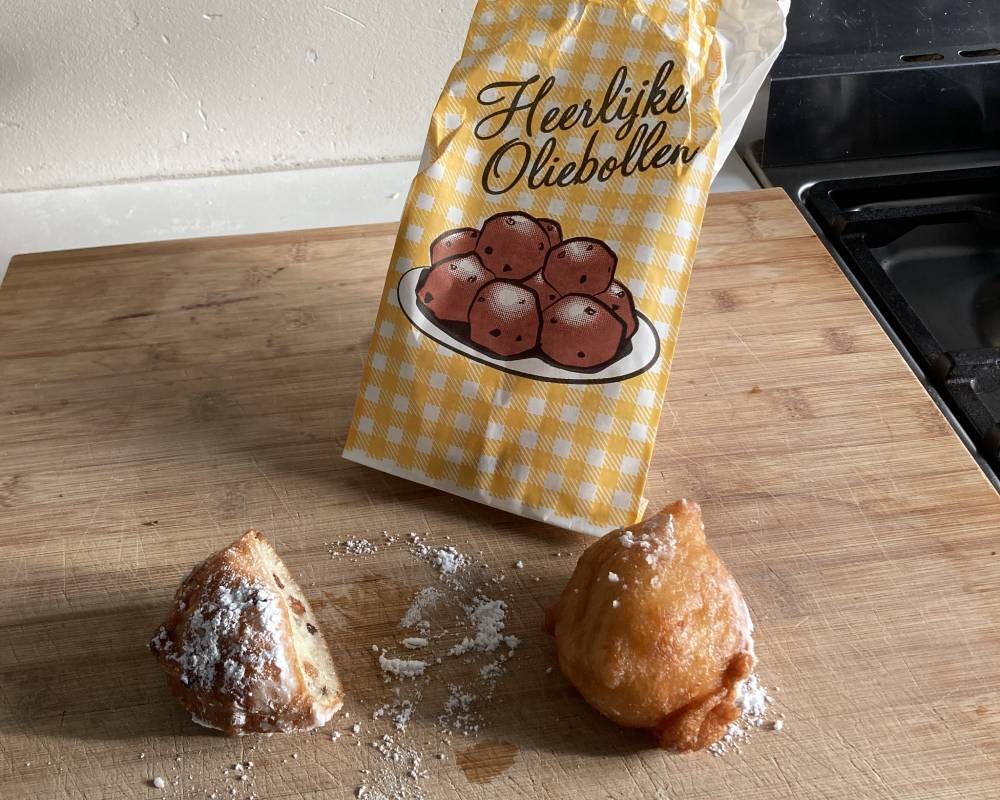
Okay, I’ll give the Dutch one thing. Their oliebollen – a satisfyingly chewy doughnut sold from carnival-type vans on street corners – is pretty good. My favourite variety has a sprinkle of raisins throughout, but you can also get them plain and dusted in powdered sugar. Since I don’t hail from a beignet country, these feel fun and novel to me, and there’s a real ‘Christmas is coming’ vibe to them.
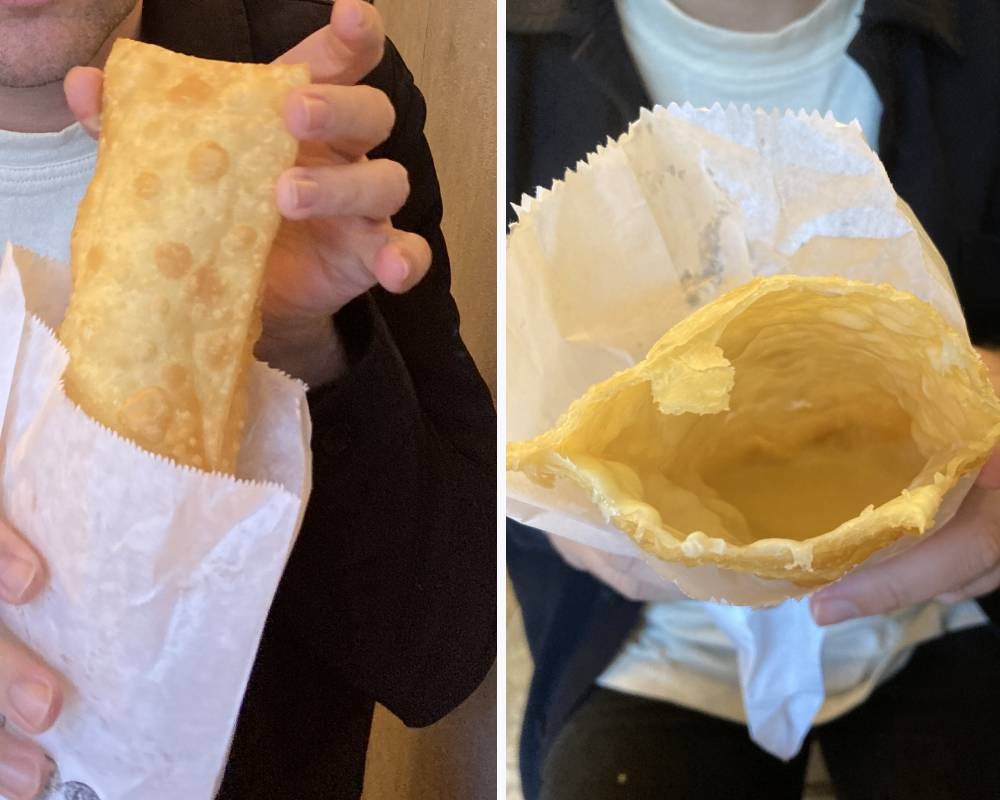
Pastel de queijo
We were in Lisbon, on our way to dinner, when Ross spotted a Brazilian pastel shop: A Pastelaria by Carol Thome. I was intent on not spoiling our appetite, but once Ross’s eyes light up there’s no stopping him, and so I surrendered to sharing a pastel de queijo. After one bite, I wanted to snatch the entire thing from him. Despite its size, the pastel was surprisingly light – essentially just a hollow, puffed up parcel with a molten cheese-streaked interior. We sacrificed our fingertips wolfing it down fresh out of the fryer, but it ended up being better than anything we had at dinner. To be fair, why eat dinner when you can eat street food.